Rick Berman Exposed in New Audio; Hear His Tactics against Environmentalists and Workers Rights
Rick Berman, the king of corporate front groups and propaganda, has been caught on tape. Listen:

Rick Berman, the king of corporate front groups and propaganda, has been caught on tape. Listen:
 Conservative columnist and Fox contributor Michelle Malkin was on Fox News with host Sean Hannity recently complaining about the "lynch mobs" going after Republican donors and organizations like the American Legislative Exchange Council (ALEC). According to Malkin, President Barack Obama is behind the grassroots efforts to push back on ALEC and on Rush Limbaugh for his offensive attacks on law student Sandra Fluke.
Hannity complained to Malkin that Democrats are, "elevating controversies like the Trayvon Martin-George Zimmerman case, Sandra Fluke case." Malkin lamented, "America has been collectively a slow learner when it comes to [President] Barack Obama." She added: "We were frustrated, you and I, trying to get the message out in 2008, and that is why we're trying overtime, redoubling our efforts to vet the president, not only his record over the last four years, but everything that led up to his grooming, the marinating in this leftist, progressive ideology."
 Recently the use of the political phrase "dog whistle" came to my attention while listening to the Sunday morning political talk shows. According to Wikipedia, "Dog-whistle politics" refers to political speechmaking or campaigning that uses coded language to signify one thing to the general public, while also signifying a different and more specific meaning to a targeted subgroup of the audience. The analogy is a reference to dog whistles, which emit an extremely high-frequency pitch that only dogs can hear, and humans can't. Political "dog-whistling" as a tactic of public persuasion can take a variety of forms.
Submitted by Anne Landman on
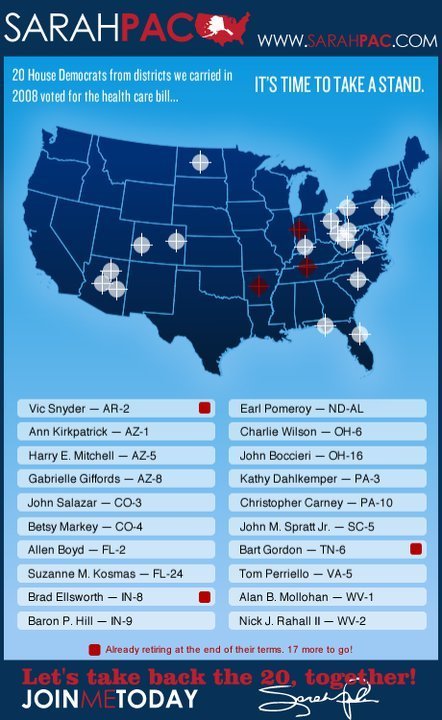 U.S. Representative Gabrielle Giffords (D-AZ), 40, was shot in the head at close range at a public event in front of a Safeway store in northwest Tucson. Giffords was one of 20 House Democrats Sarah Palin targeted last March on her Facebook page in response to their votes for health care reform. At that time, Palin posted a map of the United States with gunsight-style crosshairs superimposed over the districts of Democratic House members who had voted in favor of the health reform bill. Around that same time, a wave of threats and intimidation was ongoing against members of Congress which led Capitol Police to meet with lawmakers and advise them about taking precautions to protect their personal security. In one of the more alarming incidents, Giffords' office window was smashed on the night of the health care vote. In June, Nevada senatorial candidate Sharron Angle advocated use of "second amendment remedies" if voters fail to get their way at the ballot box.
Submitted by Steve Horn on
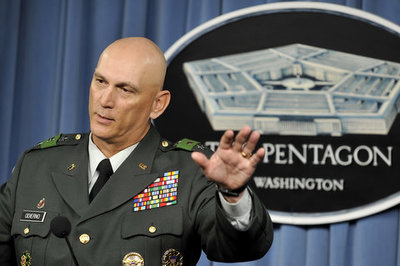 Wars are always a time of heavy propaganda and prolific spin, and as Noam Chomsky says, this system of deception is can only be maintained by what he calls "
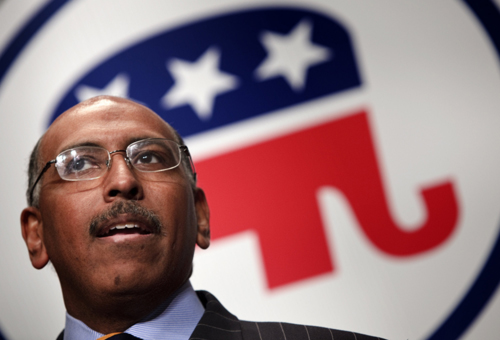 Republican National Committee (RNC) Chairman Michael Steele's latest gaffe turned a lot of heads when, speaking at an RNC fundraiser, Steele stated that the war in Afghanistan is "a war of Obama's choosing" that the American public does not want. It is obviously ludicrous to assert that the war in Afghanistan, which began in October of 2001, when Barack Obama was a state senator, was somehow chosen by the sitting president. The statement caused conservative firebrand William Kristol to call for Steele's resignation. A dismayed Kristol stated that Steele's blunder put him "at odds with 100% of the Republican Party." Unfortunately, Kristol is totally wrong to say that all Republicans disagree with Steele. While Steele's statements may be extreme, they fall in line with a widespread pattern of conservative efforts to blame Obama for problems created by President Bush.
Submitted by Anne Landman on
After months of appearing to be cooperative while quietly working behind the scenes to influence health care reform, the health insurance industry has finally launched a wholesale attack against the Senate Finance Committee's health insurance reform legislation on the day before Committee members are set to vote on the plan.
Submitted by Diane Farsetta on
After conducting "focus groups, a phone survey, an online survey" and other public opinion research, the PR firm ecoAmerica released a report on effective talking points "for speaking with the American public about energy climate change, climate solutions, renewable energy and carbon based fuels." As the New York Times noted pre
"Barack and socialism? No, our country deserves better," implored Mark Williams.
 It was only a few minutes into the October 22 rally staged by Our Country Deserves Better, a political action committee (PAC) formed to oppose the Democratic presidential candidate. But Williams, a conservative talk radio host from California, was just getting warmed up.
"Barack Obama represents people who are ashamed of this great country, who believe that this great country is the evil in the world and that, in their revisionist history, they cast us as the villain," Williams claimed. "And if we dare question them ... like Joe the Plumber: 'Mr. Obama, what are you going to do to my taxes?' That was enough for the dogs who support the ideological left to go after Joe the Plumber and shred him. ... There's no such thing as sacred, among the unholy left. They vilify this nation, and they vilify those of us who support it. ... [It's] the same kind of thuggery of the left that's used by totalitarian regimes around the world to silence opposition."
Towards the end of the rally, Williams invoked a long-discredited smear against Obama that seems designed to play on fears of his "otherness": that he's not really a U.S. citizen. "We all know that Barack Obama is not qualified to be president of the United States, beyond being above the age of 35 and probably an American citizen," said Williams, emphasizing the word "probably." He laughed and then repeated: "Probably. Even money."
Unlike his hypothetical conservatives cowed by leftist thugs, Williams will not be silenced.
Submitted by Sheldon Rampton on
In November of last year, a panel of scholars met at the New York Public Library to mark the 60th anniversary of George Orwell's landmark essay, "Politics and the English Language," and to discuss the current state of propaganda in American politics. A video from that panel is now available on the internet. How are political messages framed? How are they decoded by their audience?

Center for Media and Democracy (CMD)
520 University Ave, Ste 305 • Madison, WI 53703 • (608) 260-9713
CMD is a 501(c)(3) tax-exempt non-profit.
© 1993-2024