|
|
NavigationTopicsUser login |
mad cow diseaseWeekly Radio Spin: Better Living Through Chemical Warfare?Submitted by Diane Farsetta on Fri, 05/09/2008 - 12:53.
Topics: corporations | global warming | journalism | mad cow disease | pharmaceuticals | public relations | think tanks | U.S. government | Weekly Radio Spin
Mad Cows Coming Home to RoostTopics: agriculture | animal rights | food safety | health | international | mad cow disease
Industry Encourages More Regulation, USDA DeclinesTopics: agriculture | animal rights | corporations | food safety | mad cow disease | politics | science | U.S. government
Mad Cow USA - The Coverup Continues in WashingtonTopics: food safety | mad cow disease
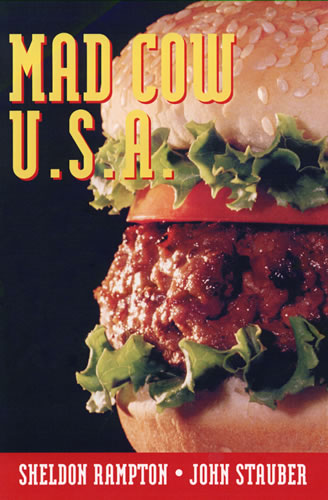
The Associated Press notes that the Bush administration "will fight to keep meatpackers from testing all their animals for mad cow disease. The Agriculture Department tests fewer than 1 percent of slaughtered cows for the disease, which can be fatal to humans who eat tainted beef. A beef producer in the western state of Kansas, Creekstone Farms Premium Beef, wants to test all of its cows," but the US government has said such private testing is illegal. "U.S. District Judge James Robertson noted that Creekstone sought to use the same test the government relies on and said the government didn't have the authority to restrict it. The ruling was scheduled to take effect June 1, but the Agriculture Department said Tuesday it would appeal, effectively delaying the testing until the court challenge has played out." Way back in 1997, the book Mad Cow USA by Sheldon Rampton and John Stauber exposed the US government's failure to protect cattle and people against this bizarre and always fatal brain disease, including the failure to adequately test US cattle. One decade later the US cover-up continues. Mad Cow Meets TerrorismTopics: agriculture | mad cow disease | terrorism | U.S. government
![]() While scant serious attention is paid to mad cow disease by the U.S. Department of Agriculture, the U.S. Food and Drug Administration and others responsible for keeping the food supply safe, some people are worried – the Idaho Bureau of Homeland Security. TheTimes-News in Twin Falls, ID reports that the threat of agroterrorism through the introduction of Mad Cow or hoof and mouth disease would have tremendous repercussions. “It’s not very likely, but if it was to occur, it would be the one (terrorist strike) that would have the most impact economically,” said Clint Blackwood, Jerome County disaster services coordinator. “It would devastate the livestock industry,” said Terry Bingham, acting area field officer for the Idaho Bureau of Homeland Security. Center for Media and Democracy staffers Sheldon Rampton and John Stauber wrote about Mad Cow disease in their 1997 groundbreaking book Mad Cow U.S.A.: Could the Nightmare Happen Here. US "Atypical" Mad Cow Threat Was PredictedSubmitted by John Stauber on Wed, 06/14/2006 - 09:33.
Topics: agriculture | food safety | mad cow disease | science The small scientific world of prion researchers -- the scientists who investigate "transmissible spongiform encephalopathies" (TSE) such as mad cow disease in cattle and Creutzfeldt-Jakob Disease (CJD) in humans -- is abuzz. That's because the two confirmed cases of US mad cow disease in Texas and Alabama are an "atypical" strain different from the British strain but identical to an atypical strain found so far in a small number of cattle in France, Germany, Poland and Sweden. The discovery of "atypical" mad cow disease in the US should not be surprising. Sheldon Rampton and I reported way back in 1997 that very strong evidence of an "atypical" TSE disease infecting US cattle was established by the work of Dr. Richard Marsh, the researcher to whom we dedicated our book Mad Cow USA. Mad Cows and Mad PoliciesTopics: health | mad cow disease | U.S. government
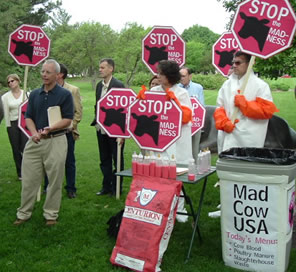
![]() CMD and Organic Consumers Association at a June 2005 USDA meeting
"Despite the confirmation of a third case of mad cow disease" in the United States, the Department of Agriculture (USDA) "intends to scale back testing for the brain-wasting disorder blamed for the deaths of more than 150 people in Europe," reports Libby Quaid. The USDA's John Clifford mentioned the decrease in testing when he announced the latest mad cow case, in an Alabama animal. The lower testing levels haven't been finalized, "but the department's budget proposal calls for 40,000 tests annually," or one-tenth of one percent of U.S. cattle slaughtered. Consumer Union's Jean Halloran called the reduction "a policy of don't look, don't find." The National Cattlemen's Beef Association's Gary Weber said, "The consumers we've done focus groups with are comfortable that this is a very rare disease." The Christian Science Monitor notes that current, higher testing levels are "far lower than the percentage tested in Europe or Japan." The new case of mad cow may delay the opening of Asian markets to U.S. beef. Harrison Returns to Corporate PasturesTopics: corporations | mad cow disease | public relations | U.S. government
Alisa Harrison, who went from being the National Cattlemen's Beef Association's executive director of public relations to being the U.S. Department of Agriculture's press secretary and director of communications, is returning to the corporate world. She's joining the PR firm APCO Worldwide as a vice president, providing "strategic counsel in developing and implementing media and public affairs programs," according to the Holmes Report. Harrison was the USDA's PR point person on mad cow disease, when it was first discovered in the United States in 2003. The Cows Have Come HomeSubmitted by Diane Farsetta on Wed, 09/07/2005 - 09:25.
Topics: corporations | mad cow disease Earlier this summer in Minnesota, the well-dressed woman walked briskly across the front of the red brick classroom and up to the microphone. The moderator smiled and nodded in her direction. Looking down at her notes, she began. "Good afternoon. Thanks for holding this session. And while we are here in this room discussing this important issue, 200 people in Gering, Nebraska, are looking for new jobs. Their packing plant closed this week because they could not source enough cattle due to the embargo."
The AMI's Janet Riley, with black wristband
Janet Riley, the senior vice-president of public affairs for the American Meat Institute (AMI), was referring to a plant owned by Packerland Packing, a subsidiary of Wisconsin-based Smithfield. The Gering plant processed roughly 320 cattle a day, turning the cows into boxed beef products. But following the May 2003 discovery of mad cow disease across the border in Alberta, a legal challenge by Ranchers-Cattlemen Action Legal Fund (a small Montana-based advocacy group) caused the United States to impose a ban on Canadian cattle imports, effectively cutting off supplies to the Nebraska plant. Speaking more slowly, Riley stressed: "Gering is not the first plant, and it won't be the last." She continued, "And that's why I and so many others in this room" - here she lifted one arm over her head and pumped it in the air defiantly - "are wearing these black wristbands, because they are the color of mourning. ... And that's exactly how we feel about our industry. What's happening is tragic." Oprah Not "The Only Mad Cow In America," Thanks to Texas Governor PerrySubmitted by John Stauber on Thu, 06/30/2005 - 07:28.
Topics: agriculture | food safety | journalism | mad cow disease A popular Texas bumper sticker reads: "The only mad cow in America is Oprah." Not anymore, after the U.S. Department of Agriculture recently announced that the first confirmed home-grown case of mad cow is a Texas beef cow. As Sheldon Rampton and I report in Mad Cow USA, the United States failed to take the measures necessary to stop the spread of the fatal dementia dubbed mad cow disease. However, a successful PR campaign by industry and government has, to this day, fooled most of the press and the public into believing that all necessary steps were taken long ago. A major part of the effort to spin and intimidate media coverage involved suing Oprah Winfrey under the Texas Food Disparagement Act, after her 1996 program examining mad cow risks in America. |
Weekly SpinRecent blog posts
The Politics and PR of Cervical CancerA four-article series by CMD's Associate Director, Judith Siers-Poisson. Upcoming events |