
Submitted by Bob Burton on
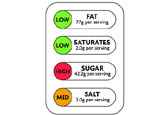 The United Kingdom government's Food Standards Agency (FSA) is planning to launch television advertisements explaining its traffic light labelling on food packaging. The label will display red, green or amber lights depending on the fat, salt and sugar content of the food. The introduction of the symbol is an attempt to reduce the rate of obesity. Felicity Lawrence reports in the Guardian that one agency regulator described opposition by the food industry industry to the new labelling scheme as "the most ferocious we've ever experienced". The director of communications at Kellogg's, Chris Wermann, said that "in principle we could never accept traffic light labelling." A coalition of food companies, including Kellogg's, Tesco, Danone, Unilever, Nestlé and Kraft are planning a major marketing campaign for their preferred labels which detail the percentage of "guideline daily amounts" of fat, salt and sugar in their products. The FSA is bracing itself for a legal action by the food industry.
 Printer-friendly version
Comments
Pani113 replied on Permalink
LameBrain Idea
It is good this is stopped, even if it is for the wrong reason. Whoever thought up this nonsense has never studied eating disorders, hasn't a clue about the psyches of fat people, and has never read about things like prohibition in the U.S. All this will do for some people is make them more tempted to the "forbidden" food. It will make others sneak food and eat more in secret than if they could enjoy it guilt free in the presence of others. It also reinforces the irrational fear that obesity is a pressing and immediate danger. In 10 or 20 years when there is famine, water shortages and mass migration due to global warming, people will thank God for a little padding! Whoever thought of the food warnings is a danger to themselves and society. Of course the food industry is slime too, but here is of one absurdity cancelling out another.
"Weight obsession is a social disease. If we cared more about CO2 than BMI there would still be time."