
Submitted by John H. Brown on
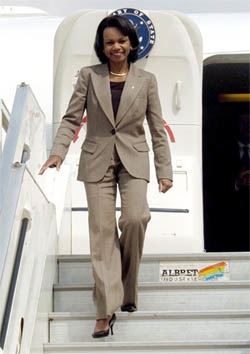
"I tell my students that policy-making is 90 percent blocking and tackling and 10 percent intellectual."--Secretary of State Condoleezza Rice, cited in Mary Beth Brown, Condi: The Life of a Steel Magnolia (Nashville, Tennessee: Thomas Nelson, Inc, 2007), p. 180.
"When you never accomplish anything, your weekly summary of what you've done all week is just a bunch of 'accondishments' -- how you've filled the days."--Noah, a reader of "Princess Sparkle Pony's Photo Blog: I keep track of Condoleezza's hairdo so you don't have to" (May 5, 2008).
Notwithstanding the low poll numbers of the president she serves, US Secretary of State Condoleezza Rice is one of the few people within the Bush administration who has managed to remain relatively unscathed by the public and by pundits. Unlike some in the president's entourage who have left Washington due to criticisms of their performance or ethics, Rice's current standing at home is sufficiently adequate from a PR perspective to allow her (up to now) to stay on in her job without too many embarrassments. True, there have been calls to remove her from her current position because of her recently disclosed role in the administration's use of torture. And doubts about Rice's qualifications as Bush's foreign-policy guru have existed for years, with, for example, her former National Security Council boss in the administration of George H.W. Bush, Brent Scowcroft, stating in 2005 that her "expertise is in the former Soviet Union and Europe. Less on the Middle East." More recently, an article by Patrick Seale, a British writer on the Middle East, talks about "The Tragic Futility of Condoleezza Rice."
But Condi, rising as she has from her solidly middle-class origins in Birmingham, Alabama to the highest echelons of the US government, remains a subject of admiration. Earlier this year the Harris Poll reported that Rice was "still the 'shining star' of the administration." A 2006 profile by BBC News gushed that "Rice's intellectual brilliance is undisputed," and she "has consistently been one of the most popular members of the Bush administration." Pundits have repeatedly floated her name as a possible Republican vice presidential running mate for John McCain. "For a party that up to now has been clueless about how to run against either a woman or a person of color, Condoleezza Rice is pure political gold," explained Nicholas Von Hoffman in a commentary for CBS News.
In fact, Rice's genius and foreign-policy expertise are more image than substance, as recent biographies by Elisabeth Bumiller and Marcus Mabry suggest. In her ascendance to power, Rice's main instrument has not been ground-breaking thinking about important international issues, but rather what Mabry characterizes as "her phenomenal skill at spinning."
A minor but telling example of Rice's self-promotion is the "Travels with the Secretary" section on the State Department website, which suggests that what she accomplishes equates with how many hours she spends in her "reconfigured U.S. Air Force Boeing 757 that is outfitted with a cabin for the Secretary, seats for the staff, and security and a communications section for continuous information anywhere in the world":
Travel Time: 1830.09 hours (76.25 days)
Total Countries Visited: 72
Total Trips Taken: 70
Rice -- as if she were a football player gaining rushing yards -- traveled 154,347 miles in 2008, the site goes on to say.
No human mind, of course, can ever be adequately evaluated (least of all by miles traveled), but does Dr. Rice actually possess the intellectual capacity needed to handle her all-important positions in the US government? Sadly, the answer is no. Despite her vaunted academic credentials, Rice has been the willing servant of an administration where intellect has little importance.
Born in the USA
The insulated setting of Rice's deep-South youth, a home-based environment controlled by her doting parents, was an important factor in making it difficult for her, even as an adult, to think creatively beyond the frontiers (or mindset) of the United States. Her upbringing did not include much domestic travel, let alone visits to foreign countries. (She did, however, make it to Coney Island on one occasion with her parents.) Sequestered Titusville, her native neighborhood, was her sheltered bubble for the early years of her life. In the words of Mabry, Rice spent "the most formative years of her life willing away realities she did not want to see."
When Condo, as her pastor father called her, was in her mid-teens, the Rices moved to Denver, Colorado, far away from the "Bombingham," of Theophilus Eugene "Bull" Connor, the Ku Klux Klan 1960s Public Safety Commissioner who was responsible for so much of the violence there. (Rice would later say that Connor "fascinated" her "because he was kind of the personification of evil.") In the mile-high city, Rice went to a then-minor heartland learnery, the University of Denver. ("Very few people go from a doctorate at the University of Denver to a first class research university ," said Donald Kennedy, Stanford president from 1980 to 1992.) It was not until her late years in college that her intellectual interests, until then limited to ice skating and piano playing, were expanded to the field of foreign affairs. As she mentioned recently at the State Department:
I was in college at the University of Denver trying to figure out my way in life and coming to the realization that if I stayed a music major I would end up playing at Nordstrom or perhaps at a piano bar -- (laughter) -- and I tried courses in English literature, and State and local government. And I hated them all. And then one day, I walked into a course in international politics taught by a Soviet specialist, a Czech émigré, a man named Josef Korbel, Secretary Albright's father.
"Before Korbel's class," Mabry points out, "Condoleezza had only glimpsed the world of international power and intrigue while sitting with her father watching the nightly news, worrying about Castro's missiles." Korbel was a defender, according to Mabry, of the Stalin-Hitler pact, which the Central European-born professor saw "as another example of Stalin's strategic genius and his success in building the Soviet state." According to Elizabeth Bumiller, when Rice heard him lecture, she
"fell in love" -- the phrase she has used in virtually every interview she has given about this moment in her life. ...
The lecture that so transfixed Rice was about the ruthless maneuvering and consolidation of power that allowed Stalin to propel himself from general secretary of the Communist Party to effective dictator of the Soviet Union. ... Terry Karl, a Stanford political science professor who later taught with Rice, [said] ... "Like some political scientists of the time, she was impressed with the efficiency and effectiveness of how the Communist parties exercised power."
A Stanford faculty member quoted by Mabry noticed that when Rice became the university's provost in the 1990s, communicating with her "was like talking to a brick wall. You'd try to say something, and she would say [banging on the table], 'No, no, no!' All I could think of was Khrushchev banging the shoe at the UN ... She was a Sovietologist; she learned her lesson well from her subjects."
Compare Rice's Soviet-centered "enlightenment" about the outside world -- focused on how the Communist parties exercised power -- with the foreign experiences of J. William Fulbright, who left his native Arkansas to be a Rhodes Scholar in England in the late 1920s. Elected Senator in 1944, he almost single-handedly established the prestigious educational exchange program that bears his name. "The essence of intercultural education," he wrote, "is the acquisition of empathy -- the ability to see the world as others see it, and to allow for the possibility that others may see something we have failed to see, or may see it more accurately." (Of course, Fulbright left much to be desired with respect to the issue of civil rights in the United States.)
Regarding Fulbright's observation about the need for empathy with the rest of humanity, Mabry's important conclusion about Rice and the outside world is of relevance:
One of the morals of [Rice's] own biography had been that what mattered was what you and your self-defined society believed, because the world beyond was often wrong in its most critical judgments. ... And that history had instilled in Rice a conviction in the veracity of her own judgments and of those closest to her, even when -- perhaps especially when -- those judgments conflicted with the "objective" reality of outsiders.
Speaking in Tongues
An important insight into how well Dr. Rice is able to understand societies distant from American shores is her putative knowledge of foreign languages, which has been hyped no end by her political supporters. "In addition to English, she speaks Russian, French, German, and Spanish," gushes the Race 4 2008 website, which calls her the "uncontested frontrunner for the Vice-Presidential slot on the 2008 GOP ticket." Yet, as a student of Russia, she never seized the considerable opportunities offered by exchange programs to learn its language in the country itself. Her lack of proficiency with Russian was ridiculed in April 2005 by Pravda (admittedly an anti-U.S. publication):
How did Condi get appointed as Secretary of State and labelled a Russian expert? Could it be that she told President Bush that she was an expert in rushin' around and he made her his "Rushin' expert"?
Asked whether she would run for President at the next election on Ekho Moskvy Radio programme, Condoleezza Rice answered Da! Nyet! Nyet! Nyet! Nyet! Nyet! Nyet! Nyet! Not bad for someone who is quoted frequently by the Western press as being a fluent Russian speaker and a Russian expert, although she has never lived in the country.
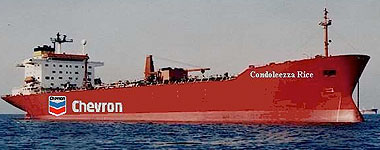 As for Rice's knowledge of French, which she studied at an early age, she herself admitted in 2006 that while she could understand a conversation with President Jacques Chirac of France in his native tongue, "I can't speak it, because I was never very good at French." As for Spanish, she was tutored in the language as a child, but while a graduate student in 1975, she said that "it was not a great time to get a job, particularly if the language you spoke was Russian, not Spanish." In all fairness to the conscientious Rice, she apparently did make an effort to learn some Portuguese on the way to her christening of the Chevron oil tanker, the M/T Condoleezza Rice, named in her honor during her tenure as a Chevron Director from 1991 until January 15, 2001.
The Doctor's Scholarship
No matter how much Rice "fell in love" with Korbel and his lecture on Stalin, an examination of her academic record suggests that she has limited ability to grasp complex issues in international affairs. Though her schoolteacher mother considered the future Secretary of State a genius (based on psychological tests Condi took at Southern University in Baton Rouge in her youth), the reactions of professors and fellow students to her intellectual accomplishments in graduate school were mixed at best. True, she had a great fan in Joseph Korbel. (Was he, as is common in turf-conscious academia, recruiting students to justify his "international" graduate program at a "city" university so that school administrators would continue his program?) At Notre Dame, however, her academic papers were assessed as follows by her adviser, George A. Brinkley, a Soviet scholar and chairman of the Government and International Studies Department:
they lacked depth and attention to different interpretations and points of view ... her evident skills and potential were not developed into more mature scholarship.
At Notre Dame, Rice received a "terminal M.A." (a degree not leading to a Ph.D.). She then returned to the University of Denver, where she wrote another M.A. thesis, titled "Music and Politics in the Soviet Union." Her adviser, Alan Gilbert, a recipient of a doctorate in political science from Harvard, remarked that her study was "not a fantastic piece" in terms of its scholarship. One of her fellow doctoral students, Wayne Glass, who went on to teach at the University of Southern California, had this to say about her:
It was just that her nature was such that she wasn't the one to throw out ideas for everyone else to grapple with.
In 1981, Rice received her Ph.D. Her dissertation was published in 1984 by Princeton University Press under the title, Uncertain Allegiance: The Soviet Union and the Czechoslovak Army, 1948-1963. While the book saw the light of day thanks to a prestigious institution of higher learning, it is rather striking for the current irrelevance of its subject matter. (Neither the Soviet Union nor Czechoslovak army exists today, although nothing in Rice's study anticipated that this would be the case.) It is also full of hollow "poli-sci" prose, as illustrated by this passage from its conclusion:
Examination of the impact of power asymmetries on the development of the nature of domestic institutions may ultimately help us to understand the concepts of power and influence themselves.
The examination of Czechoslovak party-military relations along both dimensions shows quite clearly why models developed in the study of other communist states are inadequate to explain this case. The Czechoslovak party-military apparatus, which closely resembles that of the Soviet Union, does not produce the same pattern of interaction.
The study did receive some favorable reviews from specialized journals. In the American Political Science Review, Dale R. Herspring called it a "first-rate book," noting however that it "could have been improved by a more critical use of certain concepts." But the American Historical Review -- the premier publication of the US historical profession -- panned the volume in a now well-known piece by Joseph Kalvoda, a teacher at Saint Joseph College in West Hartford, Connecticut. Kaldova mistook the author for a man, suggesting that Rice was largely unknown in the academic world (doubtless because she had published so little). Kaldova's harsh review states,
To write a scholarly study on the relationship of the Soviet Union and the Czechoslovak army without access to relevant Czechoslovak and Soviet documents is difficult. Therefore, much of this book by Condoleezza Rice is based on secondary works. His thesis is that the Soviets directly influence military elites in the satellite countries, in addition to the Soviet Communist party interacting with the domestic party. Rice selects Czechoslovakia as a case study and attempts to show the role of the military as instrument of both national defense and the Soviet-controlled military alliance.
Rice's selection of sources raises questions, since he frequently does not sift facts from propaganda and valid information from disinformation or misinformation. He passes judgments and expresses opinions without adequate knowledge of facts. ...
Rice's generalizations reflect his lack of knowledge about history and the nationality problem in Czechoslovakia. ...
The writing abounds with meaningless phrases, such as is its "last word": "Thirty-five years after its creation, the Czechoslovak People's Army stands suspended between the Czechoslovak nation and the socialist world order" (p. 245).
Rice complained to the American Historical Review in 1985 about Kalvoda's merciless critique, adding, "I apologize for the imprecise language in reporting some of the details of Czechoslovak history." In his response, Kalvoda did not surrender to Rice's sloppy scholarship:
How can one take seriously opinions and/or interpretations of someone who does not have the facts straight? In scholarly works on the Soviet bloc countries contemporary sources can be used effectively if one knows the relevant historical facts, is familiar with the political theory and practice of the Marxist-Leninists, and is able to separate facts from allegations, propaganda and outright falsehoods. Political analyses, interpretations and opinions have to be based on facts and not on misinformation.
Rice's second book, The Gorbachev Era, was coauthored with the respected scholar Alexander Dallin. It appeared in 1986, when she had already been teaching at Stanford University for several years. This 184-page collection of short essays was published by "The Portable Stanford," "a series publication of the Stanford Alumni Association. ... The PS series is designed to bring the widest possible sampling of Stanford's intellectual resources into the homes of alumni." Rice's own contribution to this slim volume without footnotes was a 12-page piece titled, "The Soviet Alliance System." Written just a few years before the fall of the Berlin wall, it stated,
In spite of all its problems, the Soviet-East European alliance has been remarkably resilient. It has survived three interventions, a Polish military takeover, and countless other less traumatic problems. The alliance is well institutionalized through CMEA [Council of Mutual Economic Assistance], which seeks, with limited success, to coordinate the economies of Eastern Europe and the Warsaw pact -- which has enjoyed greater success in mobilizing the armed forces of the region. ...
Eastern Europe, and to a lesser degree Cuba, will likely remain the center of Moscow's alliance structure for many years to come.
The article that supposedly helped Rice get tenure at Stanford, titled "The Party, the Military, and Decision Authority in the Soviet Union," was published in World Politics in 1987. Mabry quotes this assessment of the article from Lieutenant General William E. Odom, a widely admired expert on the former Soviet Union who has criticized Bush's Iraq policies:
I couldn't even figure out what she meant. [As a scholar] she just wasn't significant. It would be very hard for me to figure out why Stanford gave her tenure on [the basis of] her publication.
The abstract of Rice's article, written in academic gobbledygook, leaves little doubt -- even to a non-expert -- as to the study's lack of intellectual depth and precision:
Soviet military decision making is characterized by a division of labor between the party, which issues broad policy guidance, and the professional military, which oversees the development of the armed forces based on that guidance. There is to date no civilian institution whose functions parallel those of the General Staff. The party is now, and has historically been, dependent on the professional military for the formation of options on strategy, organization, and force composition. The Soviets have never equated civilian control and authority with civilian management. Absolute party authority over defense policy has been maintained through control of personnel and resource allocation.
Zelikow to the Rescue
Given the intellectual limitations of Rice's scholarly output, it is fair to ask what her exact role was in the drafting of the well-received volume of nearly 500 pages, Germany Unified and Europe Transformed (Harvard University Press, 1995), which she co-authored with Philip Zelikow, a lawyer, diplomat and historian. Germany Unified and Europe Transformed was a serious study that showed an in-depth analysis not found in Rice's previous two books. "A foreign affairs expert very close to Rice," Mabry notes, said that "[s]he's a conventional mind. Except for the book she did with Zelikow on Germany, the stuff she [wrote] by herself is mediocre."
The Rice-Zelikow relationship, if one is allowed to speculate, sheds light on the kind of "learned professor" Dr. Rice really is. Speaking at a Stanford symposium on the Soviet Union in May 1991, Rice herself (cited by Bumiller) said that Zelikow "has a deep knowledge of international affairs. More often than not, when something was written for him, he'd improve it, and you'd sit there thinking to yourself, 'I wish I'd thought of saying that.'"
This passage brings to mind the famous anecdote of the exchange between James McNeill Whistler and Oscar Wilde after Whistler had said something memorable. "I wish I had said that!" Wilde exclaimed, to which Whistler replied, "Don't worry, Oscar. You will, you will."
Which is what, in some ways, Dr. Rice's role in Germany Unified and Europe Transformed appears to be. Zelikow's name, despite its first letter being the last one of the alphabet, appears before Rice's on the title page of their book, making it clear that he was its main contributor. The preface of the 1995 edition notes:
This book originated in an internal historical study which a senior State Department official, Robert Zoellick, invited Zelikow to write as he was leaving the government to accept an appointment at Harvard University.
After noting that "the book is a joint effort," the preface goes on to say that "Zelikow drafted the original manuscript." Interestingly, these words (and the entire paragraph that contains them) do not appear in the "Preface to the 1995 Edition" that is included in the 1997 edition of the book. Did Rice, no doubt concerned about her lack of publications which are necessary for academic success, have something to do with this omission?
Wikipedia has this to say about the subsequent Zelikow-Rice relationship:
In Rise of the Vulcans (Viking, 2004), James Mann reports that when Richard Haass, a senior aide to Secretary of State Colin Powell and the director of policy planning at the State Department, drafted for the administration an overview of America's national security strategy following the September 11, 2001 attacks, Dr. Rice, the national security advisor, "ordered that the document be completely rewritten. She thought the Bush administration needed something bolder, something that would represent a more dramatic break with the ideas of the past. Rice turned the writing over to her old colleague, University of Virginia Professor Philip Zelikow." This document, issued on September 17, 2002, is generally recognized as a significant document in the War on Terrorism.
Don't Know Much about History
For Rice, history is not a guide, but essentially another propaganda tool in advancing immediate political interests. Her knowledge of actual historical events can be surprisingly spotty. In 2005, for example, she spoke to an audience at the Institute of Political Studies in Paris. In answer to a question from the audience, she said that in 1947, Greece and Turkey had endured civil wars. In fact, only Greece had. Guillaume Parmentier, director of the French Center on the United States, called Rice's response "a glaring mistake," adding "She's smart, yes, but I don't think she is as knowledgeable as one would expect with a career like hers."
More important than this fairly trivial error is Rice's lack of respect for historical details when the facts get in the way of her generalizations (if not fabrications) about the past. This tendency to rewrite reality was what drew the scathing Kalvoda review cited above. For another example, here are her remarks to the Veterans of Foreign Wars in San Antonio, Texas, on Aug. 25, 2003:
There is an understandable tendency to look back on America's experience in postwar Germany and see only the successes. But as some of you here today surely remember, the road we traveled was very difficult. 1945 through 1947 was an especially challenging period. Germany was not immediately stable or prosperous. SS officers -- called 'werewolves' -- engaged in sabotage and attacked both coalition forces and those locals cooperating with them -- much like today's Baathist and Fedayeen remnants.
Rice made these comments in an attempt to draw parallels between postwar Germany and the chaos that surrounded the U.S. military occupation of Iraq. By comparison to Germany, she suggested, things weren't actually going all that badly in Iraq. This drew a sharp retort from Daniel Benjamin in an essay titled "Condi's Phony History: Sorry, Dr. Rice, postwar Germany was nothing like Iraq." Benjamin pointed out that Rice's "depiction of the Allied occupation of Germany is a farrago of fiction and a few meager facts. Werwolf tales have been a favorite of schlock novels, but the reality bore no resemblance to Iraq today. ... In practice, Werwolf amounted to next to nothing."
Neil King reached similar conclusions in a January 19, 2007 Wall Street Journal article, titled "How Rice Uses History Lessons." He stated,
U.S. Secretary of State Condoleezza Rice often calls herself "a student of history." And increasingly, she is using history -- or her chosen slice of it -- both to explain and justify the Bush administration's Middle East policy.
When Ms. Rice talks about the challenges the U.S. faces across the Mideast, she points, somewhat surprisingly, to Europe after World War II and to the West's decades-long face-off against the Soviet Union, which happens to be her area of expertise. It is a penchant that has scholars scratching their heads.
In 2005, I pointed out that "the current administration and its cheerleaders cannot abandon their favorite metaphor, aimed at praising Bush's 'successes' in the Muslim world: Events in the Middle East are like the downfall of the Berlin Wall in Eastern Europe." But such a view fails as explanation or vindication of the administration's actions overseas, for two main reasons:
- Eastern Europe in the Cold War and the Middle East today simply aren't the same; it's like comparing apples and oranges, and it leads to an intellectual dead-end that elucidates little -- least of all about Bush's so-called triumphs abroad.
- Bush's foreign policy so differs from that of his Cold War predecessors that the downfall of the Berlin Wall and the current situation in the Middle East -- if indeed affected by American foreign policy in the first place -- can't be considered the outcome of similar policies that led to identical results.
As for the mistaken historical assumptions of Rice's "transformational diplomacy," her guide for what she sees as American diplomacy in our new century, please see my "Spreading Bush's Gospel" (TomPaine.com, January 30, 2006).
Rice's versions of history also appear to be an excuse for her to avoid facing problems of the present, perhaps because they are not subject to quick "spinning" solutions. This is suggested by Bret Stephens' account of her interview with the Wall Street Journal editorial board, titled "Secretary of Turbulence Condoleezza Rice takes the long view--maybe too long" (September 30, 2006):
The conversation begins with her describing herself as an academic and ends by saying how glad she'll be to return to Stanford "and do something else." She observes that her stint in the administration of George H.W. Bush took place at the end of one "great historic transformation," and that her current stint takes place at the beginning of another. Her goal for the next two years is to put "some fundamentals in place": "I don't think that this is a battle, if you will, or a struggle that's going to be won on George W. Bush's watch," she says of the war on terror. Maybe this accounts for her sang-froid -- at times seeming to border on emotional detachment -- in the face of all the reversals in Baghdad, Beirut, Cairo and Ramallah: She chooses to read the present as if it were already the past. [my italics]
In June 2003, President Bush told a group of business leaders that "This nation acted to a threat from the dictator of Iraq" [sic], but "now there are some who would like to rewrite history -- revisionist historians is what I like to call them." Here Bush, doubtless under the influence of Rice, is speaking Sovietese, for the accusation of "revisionism" was a tool frequently used by communist hacks to condemn those who dared to stray from the proclaimed ideology and its hold on the past. ("We never know," went the old Soviet joke, "what will happen yesterday.") Here is what the president of the American Historical Association, James McPherson, had to say about the Bush/Rice "revisionism":
This summer the Bush administration thought it had discovered a surefire tactic to discredit critics of its Iraq adventure. President Bush followed the lead of his national security adviser Condoleeza [sic] Rice to accuse such critics of practicing "revisionist history." Neither Bush nor Rice offered a definition of this phrase, but their body language and tone of voice appeared to suggest that they wanted listeners to understand "revisionist history" to be a consciously falsified or distorted interpretation of the past to serve partisan or ideological purposes in the present. ...
Whatever Bush and Rice meant by "revisionist historians," it is safe to say that they did not mean it favorably. The 14,000 members of this Association, however, know that revision is the lifeblood of historical scholarship. History is a continuing dialogue between the present and the past. Interpretations of the past are subject to change in response to new evidence, new questions asked of the evidence, new perspectives gained by the passage of time. There is no single, eternal, and immutable "truth" about past events and their meaning. The unending quest of historians for understanding the past -- that is, "revisionism" -- is what makes history vital and meaningful.
10 Percent Intellectual
Rice's intellectual limitations illustrate a tragic fact about the Bush administration: its conviction that ideas -- ideas stemming from observing, and learning from, the outside world; ideas resulting from scholarly research in international affairs; ideas brought about by an understanding and appreciation of the past -- have no relevance to the conduct of policy. Instead, the Bush administration uses ideas as propaganda, or simply ignores them lest they get in the way of "kicking-ass" action. Blind will to power, not in-depth thinking leading to careful planning, is what has guided the Bush administration's dealings with our small planet for the past seven-plus years. "God and exercise," Mabry quotes James Baker as saying, are the “core principles" of George W. Bush. No wonder Condi hypes her own daily workouts and proclaims her religiosity:
I've been totally unflappable in my religious faith, and believe that it is the principal reason for all that I've been able to do. My faith in God is the most important thing. I never shied from telling people that I am a Christian, and I believe that's why I've been optimistic in my life.
"[P]olicy-making is 90 percent blocking and tackling and 10 percent intellectual," Rice once stated to her students at Stanford. Perhaps more than any official White House or State Department pronouncements, this observation tells us why the Bush team has been such an utter failure on the world stage, with its mindless "blocking and tackling" leading to torture, Abu Ghraib, Guantanamo, and thousands of innocent victims of US military actions spread across the Middle East and Central Asia. The simple and sad lesson we have learned from Condoleezza Rice, Ph.D., and the 43rd President of the United States, a Yale and Harvard grad, is that action, without thought, leads to chaos and needless human suffering.
John Brown was a U.S. Foreign Service officer from 1981 to 2003.
 Printer-friendly version
Comments
Anonymous replied on Permalink
South Bashing
Mutternich replied on Permalink
Look a little closer.
Anonymous replied on Permalink
ban the truth, it's just another propaganda tool
K.Queensbury replied on Permalink
Bury your head in the sands...
R. Hilleary replied on Permalink
The mediocre intellect of Condi Rice