
Submitted by Sheldon Rampton on
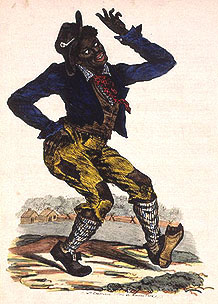
Last week I was invited to give a talk about free speech at Ferris State University in Michigan. Much to my pleasure, I discovered that one of the professors at Ferris is an old colleague, Dennis Ruzicka, who was a fellow reporter 20 years ago when we both worked for a small-town, daily newspaper in Wisconsin.
After the talk, Dennis showed me around the campus. One of our most fascinating stops was the "Jim Crow Museum of Racist Memorabilia" that has been assembled by sociology professor David Pilgrim. The Jim Crow Museum contains more than 2,000 racist artifacts, dating from pre-Civil War days to the present: cartoons, Sambo masks, Coon toys, Picaninny ashtrays, Ku Klux Klan literature, postcards with Black children portrayed as "alligator bait."
"All racial groups have been caricatured in this country, but none have been caricatured as often or in as many ways as have black Americans," Pilgrim writes. "Blacks have been portrayed in popular culture as pitiable exotics, cannibalistic savages, hypersexual deviants, childlike buffoons, obedient servants, self-loathing victims, and menaces to society. These anti-black depictions were routinely manifested in or on material objects: ashtrays, drinking glasses, banks, games, fishing lures, detergent boxes, and other everyday items. These objects, with racist representations, both reflected and shaped attitudes towards African Americans. Robbin Henderson, director of the Berkeley Art Center, said, 'derogatory imagery enables people to absorb stereotypes; which in turn allows them to ignore and condone injustice, discrimination, segregation, and racism.' She was right. Racist imagery is propaganda and that propaganda was used to support Jim Crow laws and customs."

A frequently asked questions page on the museum's website acknowledges that many people will find its artifacts offensive. "They were meant to be offensive," it observes. "They were meant to humiliate. They were used to buttress Jim Crow laws and Jim Crow etiquette." However, the purpose of the museum is not to offend but "to educate visitors about race relations in the United States. ... We believe that these items must be viewed and understood without sugar coating."

One of the surprises I encountered while browsing the displays was a copy of Ten Little Niggers, which I discovered was the original title of Agatha Christie's best-selling novel (subsequently renamed to Ten Little Indians and later to And Then There Were None). Christie's book is regarded by some as the best mystery novel ever written, and its changing title makes for quite a story all by itself. "Ten Little Indians" was originally the title of a comic song written in the 1860s by Philadelphia songwriter Septimus Winner. The song made its way to England, where another songwriter named Frank Green adapted it for use in a Victorian minstrel show, giving it new lyrics and changing "Indians" to "Niggers." In each stanza of the lyrics, one of the little niggers disappears through a different cause: "One choked his little self and then there were nine. ... One overslept himself and then there were eight. ... One said he'd stay there and then there were seven. ... One chopped himself in halves and then there were six."
Christie liked to use nursery songs for her titles, and by the time she wrote Ten Little Niggers in 1939, Green's version had become a popular children's song in the United Kingdom. Her story follows a plot similar to the song, as a series of murders are committed using methods that echo its lyrics. In later editions, however, the publisher decided that the original title could be construed as racially offensive and retitled it, also changing some of the wording of the story to soften the racial references.
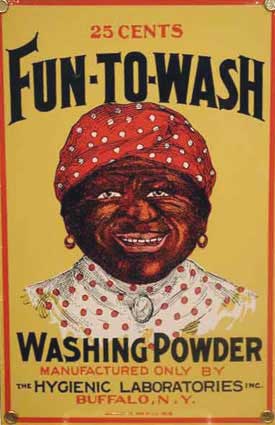
Other exhibits at the Jim Crow Museum show racial stereotyping that is more subtle. For example, the image of Aunt Jemima, a fictional character whose face appears to this day on boxes of pancake mix, beams with maternal benevolence, and over the years advertisers have given her image a makeover, lightening her skin and eliminating the bandana that she used to wear. However, she remains an example of the "mammy" stereotype that has been used in advertisements for household items including foods, detergents, planters, ashtrays, sewing accessories, and beverages.
Viewing these images can be disturbing and enlightening at the same time, and Ferris State University is providing a public service by making them available. The Jim Crow Museum is worth studying for anyone who wants to understand propaganda, and it remains relevant today. Although overt racism is less acceptable today than it was in the past, the museum includes many recently-created items, often with a harder, more hostile edge than its older items. Whereas blacks used to be portrayed as exotic, foolish and childlike, today they are portrayed as menacing, gun-toting drug addicts or as hypersexual pimps and whores. Examples include the following:
-
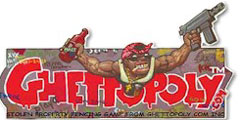 Artwork for the "Ghettopoly" board game.
Ghettopoly is a board game modeled after Monopoly, except that it belittles racial minorities. Ghettopoly has seven game pieces: Pimp, Hoe, 40 oz, Machine Gun, Marijuana Leaf, Basketball, and Crack. One of the game's cards reads, "You got yo whole neighborhood addicted to crack. Collect $50 from each playa." Whereas Monopoly has houses and hotels, Ghettopoly has crack houses and projects.
- Trash Talker Dolls, distributed by AdultDolls.net, sells dolls that stereotype various ethnic groups. Their best seller is Pimp Daddy, a chain-wearing black man who says, among other things, "You better make some money, bitch."
- The minstrel show is back too, in the person of Charles Knipp, a white man who gives performances—popular in the deep South—in which he dresses up in ragged women's clothes and blackface makeup and portrays "Shirley Q. Liquor," a trash-talking black woman with 19 children.
According to David Pilgrim,
The new racial climate is marked by ambivalence and contradiction. Most polls about race show a decline in prejudice among whites. There remains a heightened sense that racism is wrong and that tolerating 'racial others' is good; however, there is a growing acceptance of ideas critical of and belittling toward blacks and other minorities. ...
In the early 1990s I attended an academic conference in New Orleans. I searched local stores for racist objects. There were not many. Ten years later I returned to New Orleans. I found anti-black objects in many stores. This is disappointing but not surprising. Brutally racist items are readily available through Internet auction houses, most notably, eBay. Indeed, practically every item housed in the Jim Crow Museum is being sold on some Internet site. Old racist items are being reproduced and new items are being created. Each year, Halloween USA produces monster masks by exaggerating the features of Africans and African Americans.
More recently, of course, other images have been coming out of New Orleans, also imbued with racial meanings. Controversy has arisen, for example, about the contrast between news photographs of Hurricane Katrina—one with a caption that described white people "finding bread and soda from a local grocery store," while the caption to a photo of a black man carrying similar supplies stated that he had been "looting a grocery store." Other controversy followed the remarks of rapper Kanye West, when he departed from scripted comments during a Katrina fundraiser and complained that "America is set up to help the poor, the black people, the less well-off, as slow as possible. ... George Bush doesn't care about black people."
According to the Gallup polling company, "Whites and blacks have sharply differing reactions to the federal government's response to Hurricane Katrina, with blacks more likely than whites to believe that racial bias was a factor in slowing the government's response, and blacks especially critical of President Bush's performance." If we want to understand what accounts for these differing perceptions, a visit to the Jim Crow Museum may help provide some of the answers.
 Printer-friendly version
Comments
lidu replied on Permalink
Aunt Jemima
J.A.M. replied on Permalink
popular in the deep south?
Sheldon Rampton replied on Permalink
yep, popular in the deep South
J.A.M. replied on Permalink
Logic and prejudice
shakingcliches replied on Permalink
The Deep South???
Sheldon Rampton replied on Permalink
"Former"?
darkman replied on Permalink
Strange...
phyllis replied on Permalink
Jim Crow legacy